_1772746035263-CVlnBaHI.png)

Utility-Scale Renewable Energy · Southeast Texas
Improving In-Building Cellular Coverage at Utility-Scale Solar Power Plants
A utility-scale solar power generation client engaged Twin Eagle Solutions with one goal: improving in-building cellular coverage at their solar power plants. We solved a chronic dead-zone problem across multiple substation control buildings: reinforced concrete, steel, and metal-clad enclosures that severely attenuate RF in already-rural macro coverage. We designed, installed, and commissioned Nextivity CEL-FI GO G43 smart signal boosters at every site, carrying AT&T, T-Mobile, and Verizon including 5G bands where available.
3
Carriers boosted simultaneously (AT&T, T-Mobile, Verizon)
66 dB
RSRP improvement on the worst-performing band (-118 → -52 dBm)
5G
Bands supported alongside LTE where available
Multi-site
Standardized design replicated across solar plants
The Business Challenge
Rural macro coverage, met by an RF-shielded substation envelope.
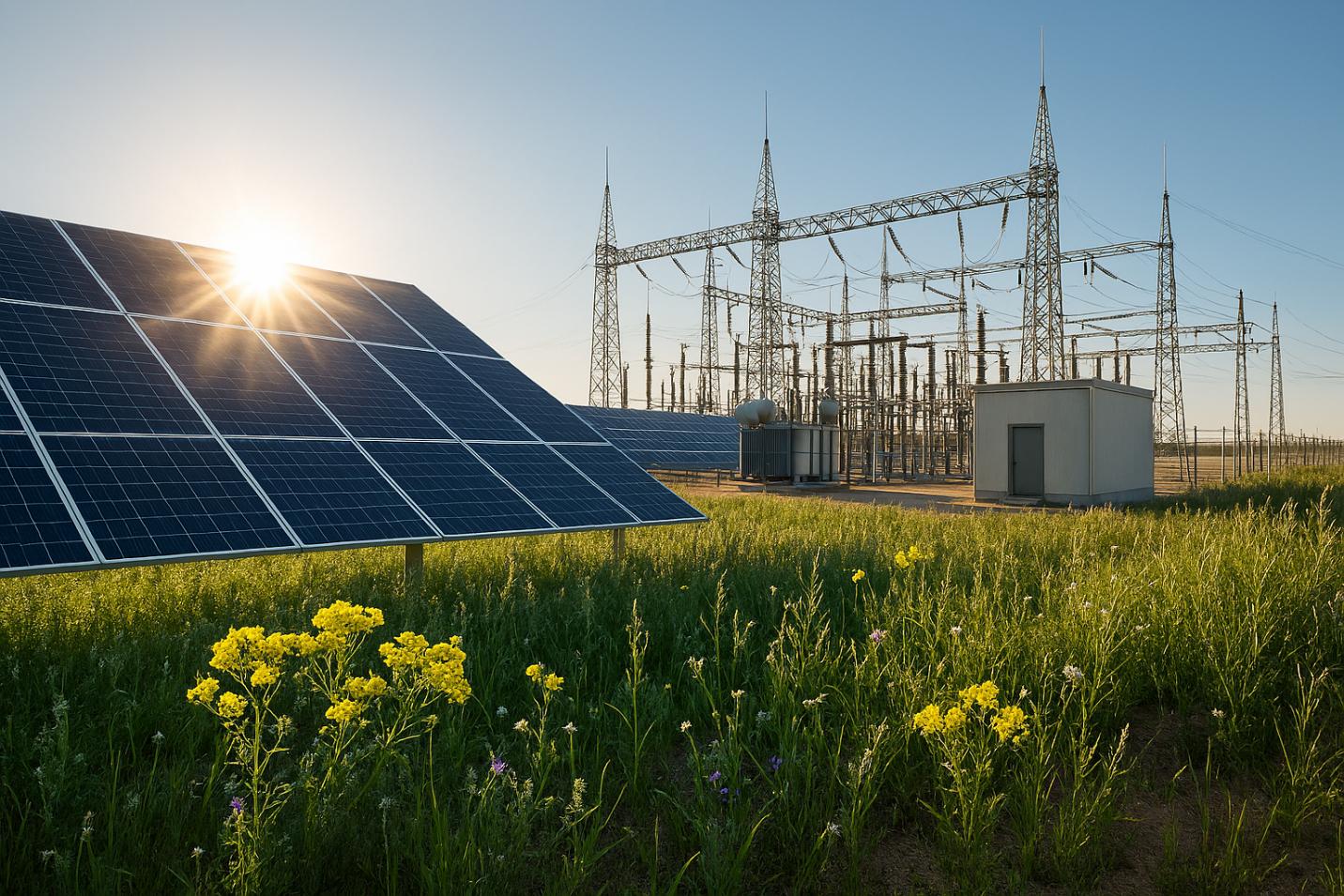
Utility-scale solar power plants are frequently constructed in remote and rural locations where macro cellular network density is limited and baseline carrier signal levels can already be marginal. While those locations are ideal for renewable energy production, they present significant challenges for reliable wireless communications.
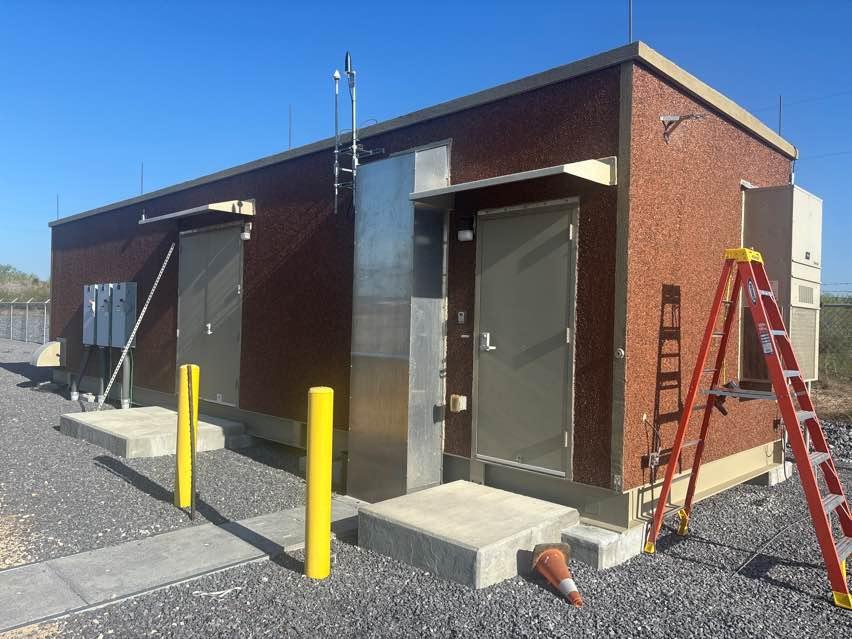
Within these sites, substation control buildings pose an additional layer of difficulty. They are purpose-built to withstand harsh environmental conditions such as extreme heat, dust, wind, and electrical interference, and are typically constructed using reinforced concrete, steel, and metal-clad enclosures that severely attenuate radio frequency signals.
At this client's sites, the combination of limited rural carrier coverage and RF-shielding building construction resulted in:
- Minimal to nonexistent cellular signal inside substation control buildings
- Inability for personnel to reliably place or receive voice calls
- Poor data connectivity impacting commissioning, maintenance, and troubleshooting
- Lack of consistent service across major mobile network operators
Because plant personnel rely heavily on cellular connectivity for operational coordination, remote support, and safety-critical communications, unreliable in-building coverage introduced both operational inefficiencies and potential safety risks. The client engaged Twin Eagle Solutions to design and deploy a robust, carrier-agnostic solution capable of overcoming these environmental and structural challenges across multiple solar sites.
The Technology Solution
Nextivity CEL-FI GO G43: three carriers, one carrier-approved system.
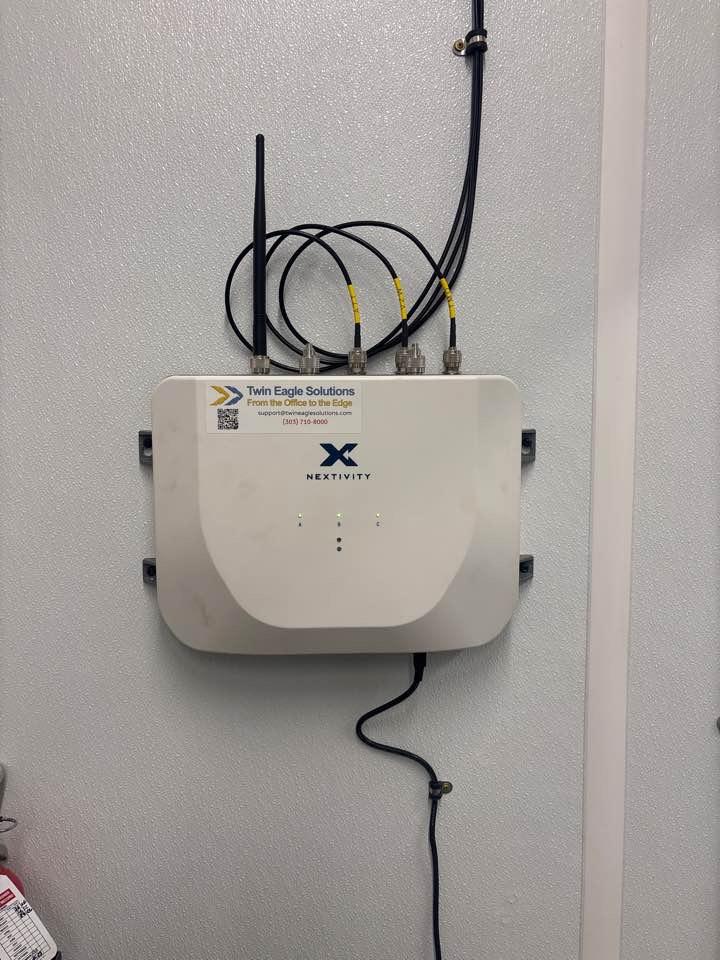
After evaluating existing site infrastructure and reviewing available coverage options, Twin Eagle selected the Nextivity CEL-FI GO G43 smart signal booster. The G43 supports simultaneous amplification of up to three carriers, is carrier-approved and operator-safe, and dynamically adapts to changing RF conditions, making it well-suited to critical infrastructure and industrial environments.
At the core of the system is Nextivity's patented IntelliBoost technology, which continuously maximizes uplink and downlink signal levels without injecting interference back into the macro network. That self-optimizing behavior enables best-in-class signal quality inside challenging RF environments like substation control buildings.
Twin Eagle designed, installed, and commissioned CEL-FI GO G43 systems at multiple solar sites, using site-specific survey and as-built data to ensure optimal antenna placement and per-carrier performance.
Nextivity CEL-FI GO G43
Carrier-approved smart signal booster
The CEL-FI GO G43 amplifies signal from up to three mobile network operators simultaneously, is carrier-approved and operator-safe, and dynamically adapts to changing RF conditions, purpose-built for critical infrastructure and industrial environments where reliability matters.
Nextivity IntelliBoost
Self-optimizing RF engine
IntelliBoost continuously maximizes uplink and downlink signal levels without injecting interference back into the macro network. The result is best-in-class signal quality even inside RF-shielded substation control buildings where the macro signal arrives weak and noisy.
Outdoor Donor + Indoor Server Antennas
Engineered antenna system
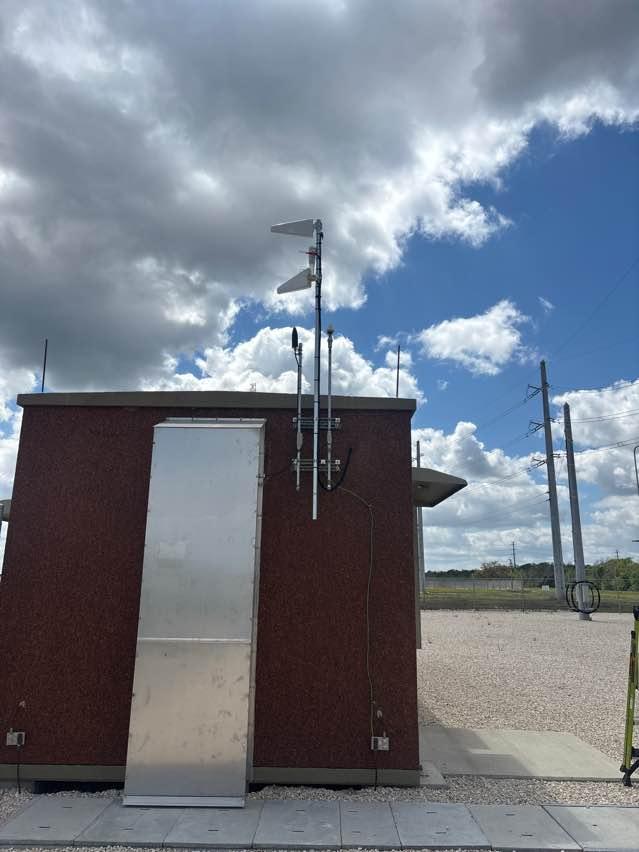
Outdoor donor antennas are positioned to capture the strongest available macro-network signal from each carrier, and indoor server antennas are placed to distribute that boosted signal uniformly throughout the control building, both engineered against site-specific survey data and the building's as-built layout.
Multi-Carrier LTE + 5G
Carrier-agnostic indoor coverage
The deployed systems carry AT&T, T-Mobile, and Verizon, including 5G bands where the macro network supports them, so plant personnel get usable voice and data on whichever carrier their device is on. No more carrier-specific dead zones inside the building.
Deployment Overview
Survey-driven antenna engineering, then field-tuned per carrier.
Each deployment was driven by site-specific survey and as-built data, not a templated install. Outdoor donor antennas were positioned to capture the strongest available macro-network signal at each location. Indoor server antennas were engineered for uniform signal distribution within the control building. Systems were then configured and optimized against real-world RF measurements taken on-site, carrier by carrier and band by band.
Field Results · RF Performance
From no detectable signal to reliable LTE and 5G across every major carrier.
Post-deployment testing demonstrated dramatic improvements in signal strength and quality across all carriers and supported bands. Before deployment, many carriers showed no detectable signal inside the building; where signal existed, RSRP levels were as low as -118 dBm, well below usable thresholds, with RSRQ values indicating poor quality and instability. After deployment, all major carriers achieved strong, usable LTE and 5G coverage, RSRP between -77 dBm and -52 dBm, with RSRQ stabilized in the -11 to -16 dB range.
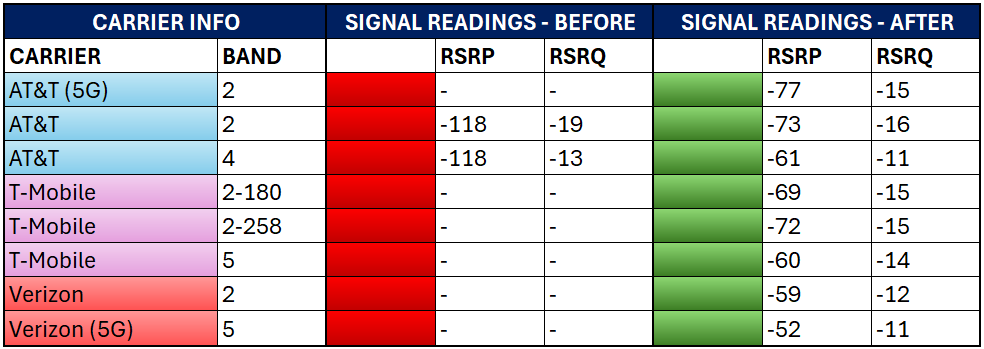
-52 dBm
Best post-deployment RSRP (Verizon 5G, band 5)
All 3 MNOs
AT&T, T-Mobile, and Verizon: LTE plus 5G where available
Reliable indoor cellular coverage across every major MNO and supported band.
Business Impact
One standardized design, replicated across the fleet.
By deploying a standardized in-building cellular solution across multiple solar power plants, the client achieved:
- Reduced operational disruptions caused by poor connectivity
- Improved response time during maintenance and troubleshooting
- Increased confidence in communications during critical plant activities
- A scalable solution that can be easily replicated at future sites
What Twin Eagle Delivers
Survey, design, install, commission, repeat.
The same engineering and field team handles every phase, from the initial site walk through commissioning and per-carrier optimization, so the design that ships to the next site reflects everything learned at the last one.
- Site-specific RF survey and donor antenna line-of-sight assessment
- Carrier coverage modeling against pre-existing macro signal levels
- Nextivity CEL-FI GO G43 system design and bill-of-materials
- Donor and server antenna placement engineering against as-built drawings
- Cable routing, grounding, and lightning protection inside the substation envelope
- On-site installation, commissioning, and carrier-by-carrier optimization
- Pre- and post-deployment RSRP / RSRQ measurements on every supported band
- Standardized design package replicable across additional solar sites
- Coordination with the operator's IT and safety stakeholders end-to-end
Why It Matters
The right technology, thoughtful design, and field-proven execution.
Twin Eagle Solutions delivered a carrier-agnostic, high-performance in-building cellular solution tailored to the unique demands of utility-scale solar infrastructure. Leveraging Nextivity's IntelliBoost technology and Twin Eagle's RF engineering expertise, the CEL-FI GO G43 platform provided consistent, reliable connectivity where it was previously unavailable, demonstrating how the right combination of advanced technology, thoughtful design, and field-proven execution can solve even the most challenging RF environments.