_1772746035263-CVlnBaHI.png)
Customer Success Story · Oklahoma Independent Producer
Reducing LOE and Spill Liability with Remote Pumper
How a small Oklahoma operator running 200 aging stripper wells turned a razor-thin LOE problem into a modernized, highly profitable operation, with $1.3M+ in annualized ROI on a single managed-service contract.
$1.3M+
Total annualized ROI across 200 wells
300%
Pumper efficiency gain, from 40 to 120+ sites
95%+
AVA LLD verification accuracy on leak alerts
<1 Mbps
Bandwidth per site for 24/7 AI monitoring
_(1)_1777608279645-CTmz_Sr4.webp)
The Industry Reality
The razor's edge of stripper-well margins.
Marginal and stripper wells are the unsung backbone of domestic oil production, but operating them is a relentless financial tightrope walk. When a well produces only a handful of barrels a day, profitability is dictated almost entirely by Lease Operating Expenses (LOE).
For a small independent operator in Oklahoma managing 200 wells, the math was becoming unsustainable. Their portfolio consisted almost exclusively of aging stripper wells averaging just 8 BOPD. With oil markets historically volatile, any dip below $60 per barrel threatened to push the company into the red, making the difference between corporate survival and insolvency a matter of pennies per barrel.
Before engaging Twin Eagle Solutions to deploy the Remote Pumper platform, this operator was bleeding capital on two major fronts: exorbitant pumper costs and catastrophic spill liabilities.
The Twin Eagle Advantage
Zero-lift integration, white-glove support, for $9 a day.
A technology solution is only as good as its deployment. Small independent operators rarely have dedicated internal IT teams, network engineers, or the CapEx budgets to design and maintain complex AI camera networks. They needed a partner who could shoulder the entire technological burden.
They chose Twin Eagle Solutions because of our 26-year pedigree in industrial integration and our fully-managed, white-glove service model. For a simple $9 per day, per site, Twin Eagle delivered a completely provisioned, 100% on-premise lease package. The operator did not have to lift a finger to build this ecosystem.
- Engineering and sourcing of self-contained solar skids and rugged edge hardware
- Field installation across all 200 sites
- Complete network integration
- System provisioning, dashboard setup, and pumper training
- Ongoing 24/7 maintenance: Twin Eagle rolls the truck, not the operator
Big Winner #1: Operational Savings
Transforming the LOE equation.
The operator was using a highly traditional, localized approach to lease management. Pumpers managed routes of roughly 40 sites each, driving out to physically visit every well every two to four days.
Fully-loaded pumper expense (wages, truck, fuel, insurance, maintenance) ran $27.75 per site, per day. At 8 BOPD per well, simply checking the wells was costing an astonishing $3.46 per barrel in pumper expense alone. Pumpers were spending hours a day staring through windshields, burning fuel and vehicle depreciation to visit pads that were operating perfectly fine.
The Remote Pumper impact: tripling efficiency
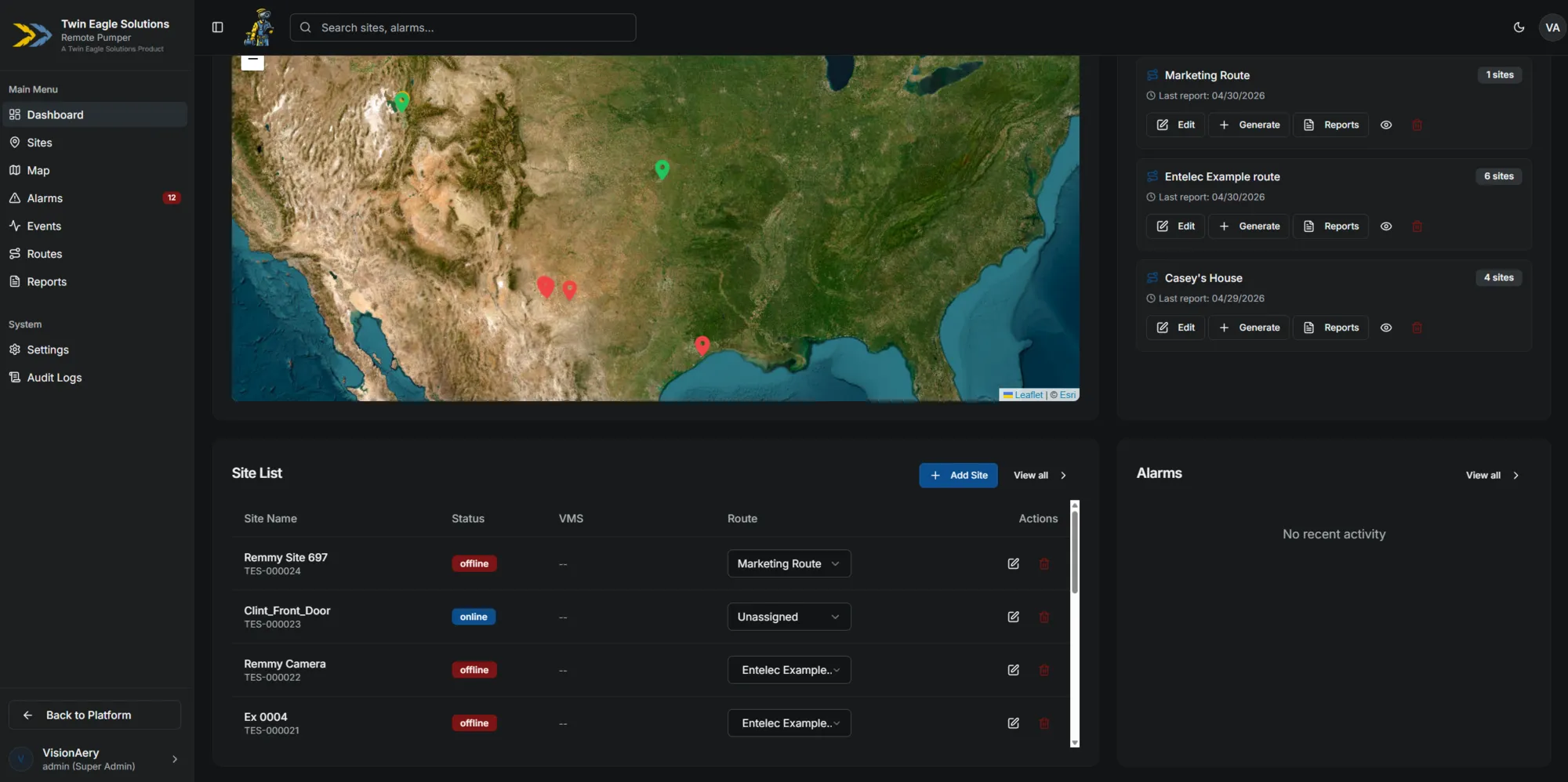
Twin Eagle fundamentally transformed the operator's daily workflow from "Pump by Schedule" to "Manage by Exception." Every morning, pumpers receive visual reports, including high-definition images, video clips, and audio from every well site, before they ever start their trucks.
A single email per route. Each well shows current status, location, a fresh field image, and a one-click button to watch the latest video clip, all before the truck door opens.
Pumpers only visit sites that the visual reports or AI flag as requiring attention. Wells that are running smoothly are left alone, sometimes safely going a month without a physical truck driving onto the pad. By eliminating useless windshield time, pumper efficiency skyrocketed by 300%, allowing a single operator to seamlessly manage 120 or more sites, up from 40.
The financial breakdown
- Original pumper cost$3.46 / bbl
- New pumper cost (3× efficiency)$1.15 / bbl
- Remote Pumper tech lease ($9/day ÷ 8 BOPD)$1.12 / bbl
- New total cost (labor + tech)$2.27 / bbl
By shifting the workload to AI, the operator reduced their per-site monitoring costs by ~35%, saving $1.19 per barrel, or $9.52 per site, per day. Across 200 wells, that generates $694,960 in direct, guaranteed operational savings every year. For a small independent producer, adding nearly $700,000 straight to net operating income is a game-changer. It drastically lowers the break-even threshold, insulates against crude price drops, and secures long-term survival.
Big Winner #2: Risk Mitigation
The massive hidden ROI of instant spill detection.
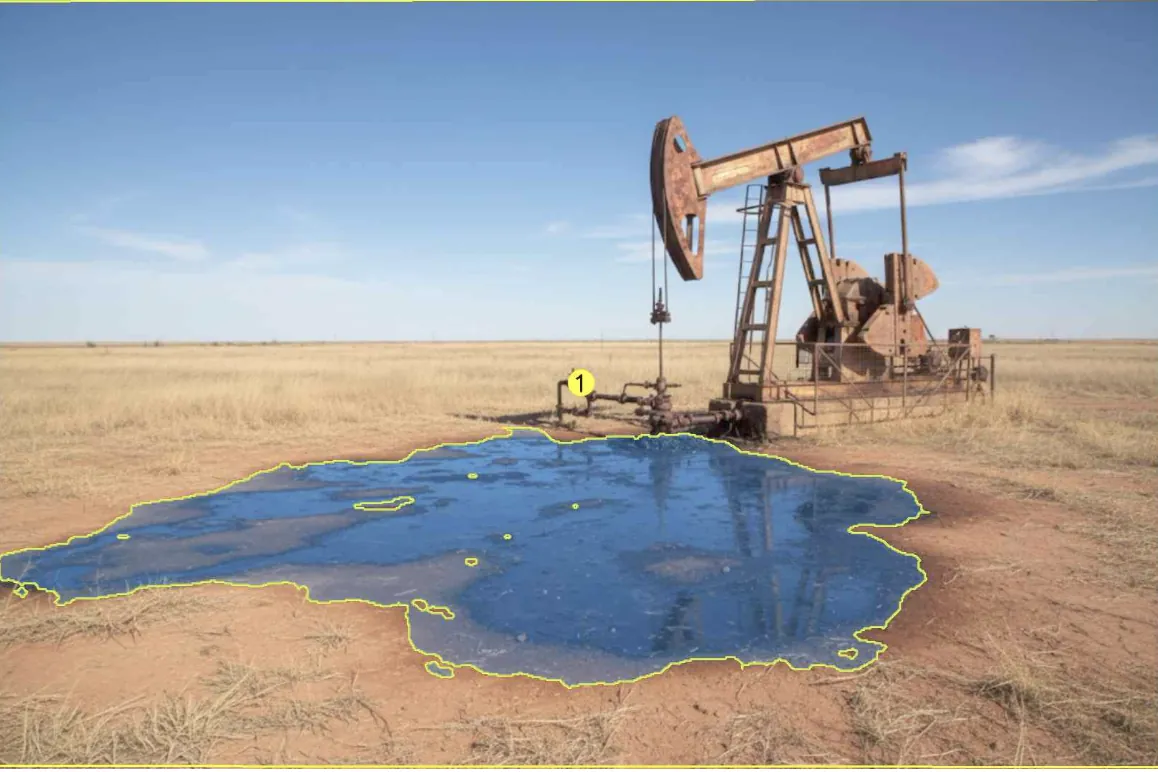 VisionAery LLD overlay
While the $700K in operational savings easily justified the technology, the return on investment in risk mitigation proved to be equally, if not more, lucrative.
Aging infrastructure is a harsh reality. The operator's equipment was so prone to failure that field teams jokingly referred to some trouble sites as "sprinkler systems" rather than pumpjacks. They were experiencing an average of 20 spills per year, a 10% spill rate, nearly double the industry average of 5.5%.
The true cost of a delayed response
Because a pumper only visited a site every two to four days, a blown seal, stuffing-box failure, or cracked line could leak unchecked for up to 96 hours. By the time it was discovered, a minor mechanical failure had become an environmental disaster.
Late-detection costs are brutal: vacuum truck services, heavy equipment for soil excavation, hauling and disposing of contaminated dirt, fresh backfill, environmental consulting, state fines, and 2–3 years of mandated groundwater monitoring. Production is shut-in for days or weeks.
These incidents routinely cost $25,000 to $50,000+ each. At 20 spills a year, the operator was facing $700,000 to $1,000,000 annually in pure environmental liability and lost production.
The Anatomy of Detection
Distributed AI: overcoming bandwidth bottlenecks and alert fatigue.
A major hurdle in deploying AI on remote stripper wells is network infrastructure. Streaming 24/7 high-definition video from 200 field locations requires massive bandwidth, which is both technically unfeasible and astronomically expensive in the oilfield.
Legacy leak detection systems are also notorious for false positives, triggering alarms over rain puddles or shadows, leading to "alert fatigue" where operators eventually ignore the warnings. Twin Eagle engineered a masterclass in distributed AI architecture to solve both problems simultaneously, splitting the AI processing between a local edge app and a central on-premise server. The result: hyper-accurate detection at under 1 Mbps per site.
Stage 1
Edge computer vision: zero-bandwidth 24/7 monitoring
VisionAery's Liquid Leak Detection (LLD) app runs locally on rugged edge compute hardware directly at the well pad. It continuously pulls the camera's RTSP stream at a deeply optimized 1 frame per second, so no live video ever traverses the network for monitoring. The LLD algorithm is trained specifically to identify the visual characteristics of pooling liquids. The moment a seal blows and oil begins pooling, the edge app flags the anomaly.
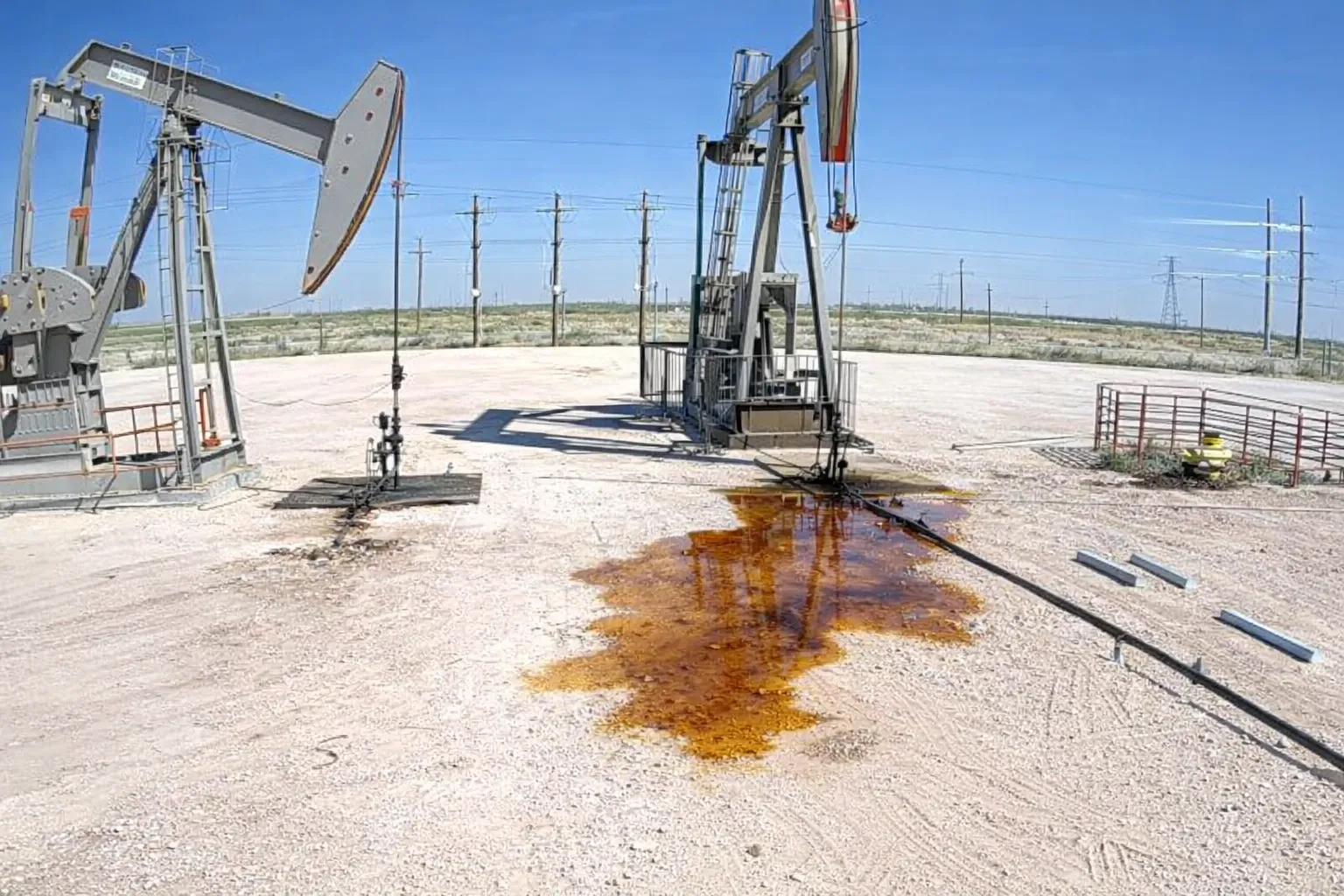 Raw camera frame
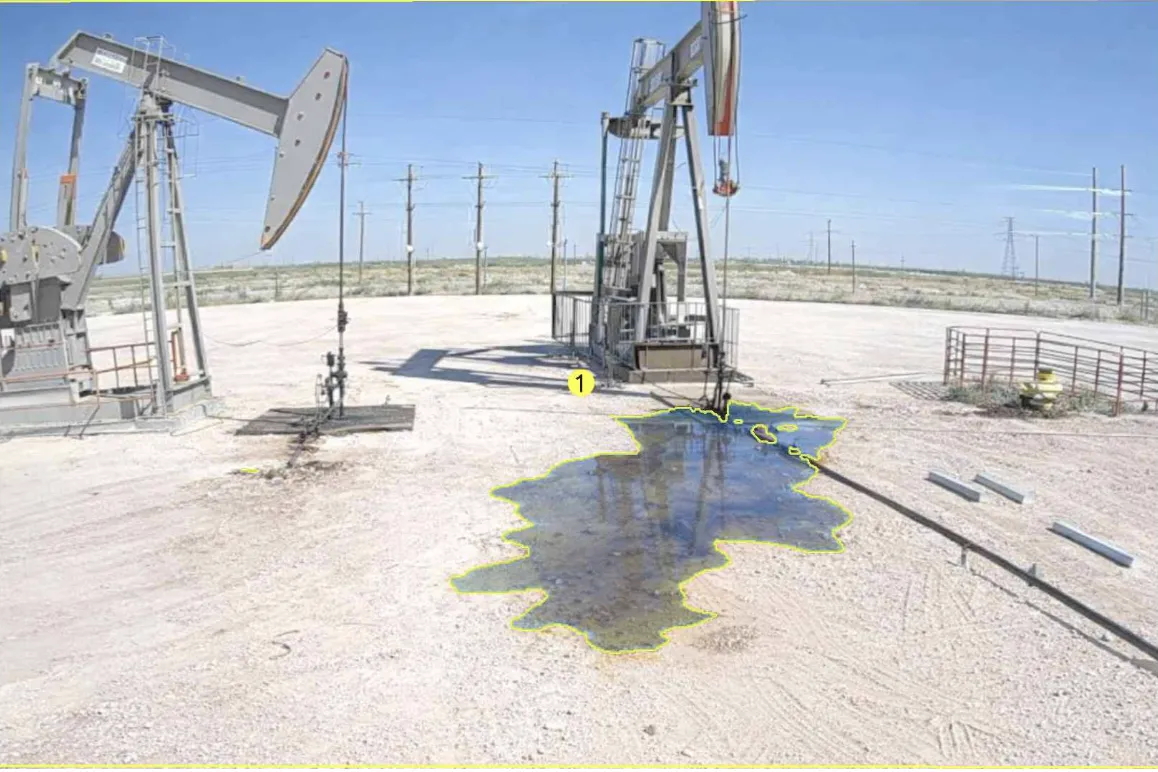 VisionAery LLD overlay
Stage 2
Lightweight payload + central AVA LLD verification
Once the edge app detects a leak, it doesn't stream a video to sound the alarm. Instead, it generates an ultra-lightweight MQTT payload containing a Base64-encoded snapshot of the anomaly, plus a small 30-second video clip. That tiny payload is sent to the central on-premise location where AVA LLD: our Alarm Verification Agent resides.
AVA LLD is an advanced Vision Language Model (VLM), housed centrally because its heavier inference belongs on bigger compute. AVA LLD acts as a cognitive gatekeeper. Instead of just seeing "liquid," AVA LLD asks contextual questions: Is the liquid spreading from a piece of equipment? Did it just rain? Is that just a shadow from the pumpjack arm?
The result is 95%+ accuracy in confirming or dismissing alerts. If AVA LLD confirms an active spill, it instantly pushes verified notifications and images directly to the pumper.
The Bandwidth Triumph
Enterprise-grade AI over standard cellular and basic radio.
Because the system only sends lightweight data packets, snapshots and short clips, when an event actually occurs, overall network bandwidth rests at under 1 Mbps. The only time data usage spikes above that threshold is when an operator manually pulls up a camera to stream a live view. The architecture delivers enterprise-grade AI monitoring over standard cellular or basic radio connections without crippling the network.
The Remote Pumper Impact
Turning disasters into routine maintenance.
With this ultra-efficient, two-stage AI running 24/7, leaks are caught in seconds and verified with near-perfect accuracy. Catching a leak that fast turns a disaster into a routine maintenance task: the operator simply dispatches a vacuum truck to suck up a few barrels of contained fluid for $2,000 to $3,500, fixes the mechanical issue, and restarts the well the same day.
By preventing those 20 incidents from becoming reportable disasters, the operator recognized an additional $600,000+ in escaped liability and preserved production output, pushing the total annualized ROI of the Remote Pumper system to well over $1.3 million.
The Results
A vulnerable producer, transformed into a modernized enterprise.
$1.3M+
Total annualized ROI across the 200-well portfolio
300%
Pumper efficiency gain: 40 sites to 120+ per operator
95%+
AVA LLD verification accuracy: alert fatigue eradicated
The operator slashed their lifting costs, tripled their workforce efficiency, eradicated alert fatigue, and neutralized their environmental liability, insulating the business against crude price swings and turning a marginal portfolio into a resilient one.
Total Project Financial Breakdown
The full picture: 200 wells, one annual P&L.
Rolling every line item up to the full portfolio, here is what a single year of Remote Pumper actually does to the operator's books. Operational labor is modeled at 8 BOPD per well across all 200 sites; spill exposure uses the documented 20 incidents per year at $25K–$50K per reportable event.
Before Twin Eagle: annual cost across 200 wells
- Pumper labor & trucks ($27.75/site/day × 200 × 365)$2,025,750
- Spill liability exposure (20 spills × $25K–$50K)$700,000 – $1,000,000
- Subtotal$2.73M – $3.03M
After Twin Eagle: annual cost with Remote Pumper
- Pumper labor & trucks at 3× efficiency ($9.25 × 200 × 365)$675,250
- Remote Pumper managed lease ($9/day × 200 × 365)$657,000
- Routine spill maintenance (20 events × $2K–$3.5K)$40,000 – $70,000
- Subtotal$1.37M – $1.40M
- Total annualized ROI$1.3M+
At a project cost of $657K/year in technology, Remote Pumper returns roughly $2 of net savings for every $1 spent and the producer keeps every dollar of that savings as net operating income.
Pricing & Configuration
Lease or own: built to fit any well's economics.
The Oklahoma operator chose the 100% on-prem managed lease at $9/day per site, but Remote Pumper is offered across multiple deployment models: Cloud Hybrid or 100% On-Prem, Lease or CapEx, with Remote Pumper Pro available when you need an on-premise IPC server for higher accuracy and additional analytics.
Lease Installation & maintenance included | CapEx Hardware Purchase hardware, lower daily rate | |||
|---|---|---|---|---|
| Configuration | Cloud Hybrid | 100% On-Prem | Cloud Hybrid | 100% On-Prem |
Remote Pumper AI camera with on-camera LLD | $8 /day per site | $9 /day per site | Per site hardware$5,200 Daily rate$2/day | Per site hardware$5,200 Central server$6,000 Daily rate$2.50/day |
Remote Pumper Pro IPC server for higher accuracy & more analytics | $10 /day per site | $12 /day per site | Per site hardware$6,600 Daily rate$2/day | Per site hardware$6,600 Central server$6,000 Daily rate$2.50/day |
Custom Config Add cameras, analytics, services & more | Custom pricing based on your configuration | |||
Remote Pumper
AI camera with on-camera LLD
Remote Pumper Pro
IPC server for higher accuracy & more analytics
Custom Config
Add cameras, analytics, services & more
Why It Matters
Twin Eagle didn't sell a camera system; we engineered a rescue.
By handling 100% of the hardware, software, integration, and maintenance, Twin Eagle empowered the operator to focus purely on producing oil. Through the Remote Pumper platform, brilliant bandwidth-optimizing edge architecture, and the unparalleled accuracy of the AVA LLD verification engine, a vulnerable, high-LOE independent producer became a modernized, highly profitable enterprise capable of thriving in any market condition.