_1772746035263-CVlnBaHI.png)
Hardware Platforms · Skids & Trailers
Industrial Camera Skids & Trailers
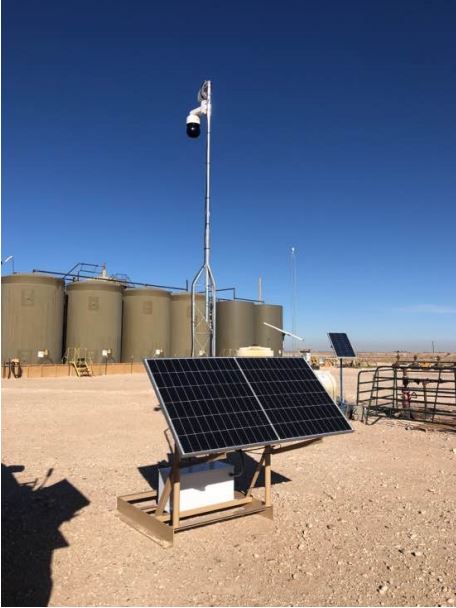
Custom steel platforms that integrate cameras, edge-AI compute, solar power, mast, backhaul, and a NEMA-rated cabinet as one bench-tested system. Drop one on the pad, level it, and the site is online — no civils, no trenching, no waiting on a power drop.
What "industrial camera skids and trailers" actually means
Twin Eagle Solutions has been designing, integrating, and field-deploying industrial camera skids and trailers for oil & gas, water/wastewater, utility, mining, construction, and perimeter-security operators across the lower 48 states for more than two decades. Every platform is engineered as a single bench-tested system — steel skid or road-rated trailer chassis, telescoping or fixed mast, off-grid solar with battery autonomy, NEMA-rated equipment cabinet, integrated cameras, edge-AI compute provisioned with VisionAery analytics, and a backhaul path engineered against the actual site — not assembled in the field from a catalog of parts.
The discipline matters because field-built camera platforms fail in predictable ways: undersized solar arrays that brown out in winter, masts that twist under wind load, cabinets that overheat in the sun, surge events that take out the edge compute, cable bundles that chafe through their jackets, and analytics that were never bench-tested against the actual scene. Twin Eagle Solutions engineers each of those problems out in the shop — where a fix costs a couple of hours, not a truck roll to a remote pad.
The same in-house team that integrates the platform deploys it in the field, commissions the cameras into the operator's VMS, validates the analytic alarms against ground-truth events, and stays on the asset through Twin Eagle's 24/7 callout-supported managed services. There is no integrator handoff, no scope gap, and no excuse trail when something doesn't come up the way it did on the bench.
Six capabilities that make up the platform
Steel Design & Custom Fabrication
Every Twin Eagle Solutions camera skid and trailer starts as a 3D mechanical design and a structural calculation, not a stock catalog item. We engineer the steel frame, the mast pocket, the solar-array sub-frame, the equipment-cabinet floor, and the cable runs to the actual camera, mast, solar, battery, and enclosure footprint the scene requires, and the frame is custom-built to that spec by our fabrication partners. Skid base sizes, lifting eyes, forklift pockets, anchor points, and transport tie-downs are all engineered for the basin, the road, and the pad — not for an average. The result is a platform that lands square on uneven caliche, doesn't twist under wind load, and stays serviceable for the entire deployment.
Solar Sizing, Battery Autonomy & Power Systems
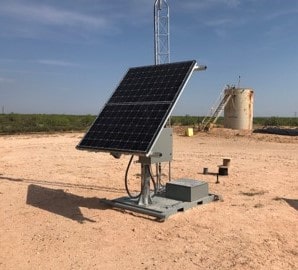
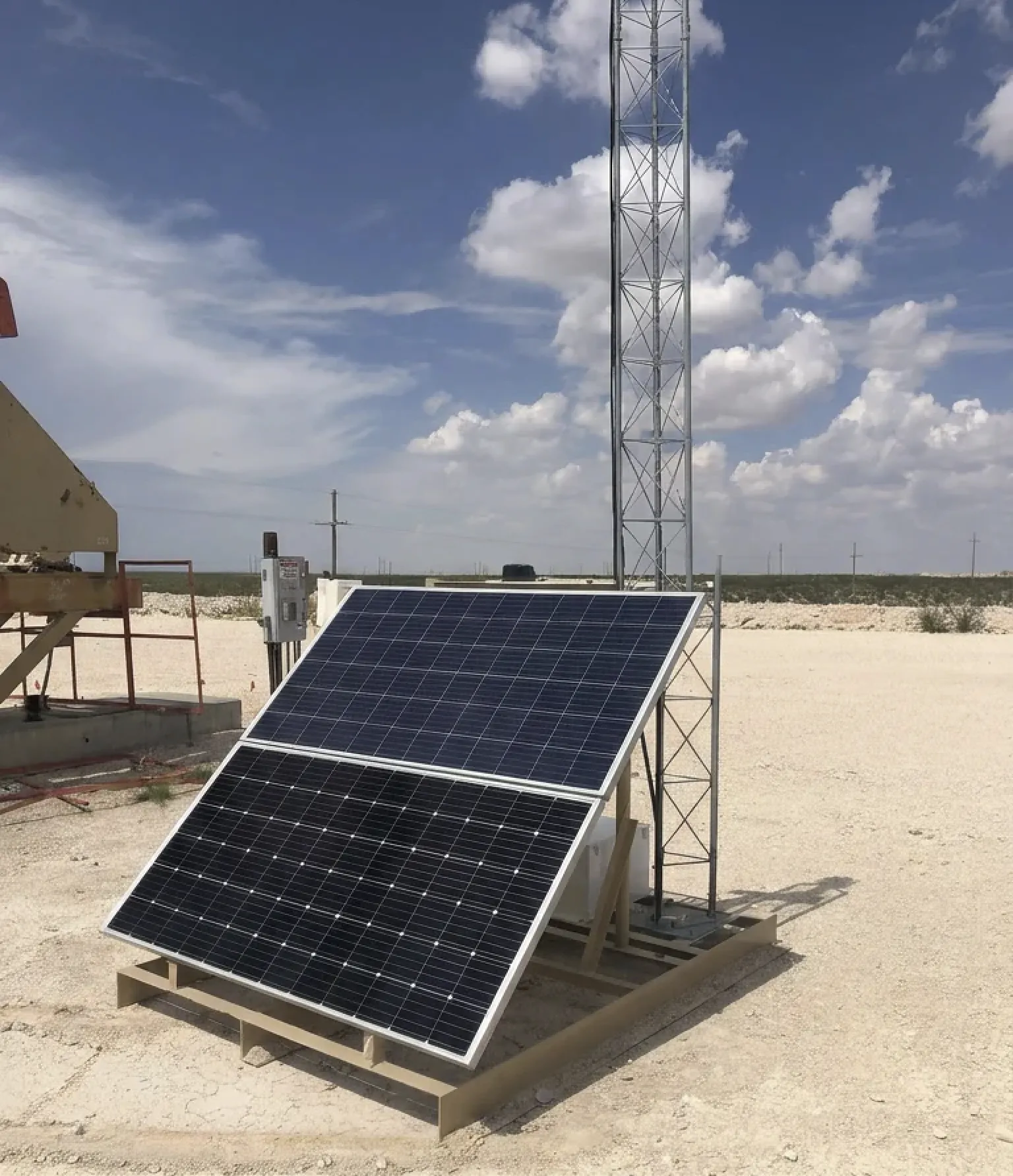
Solar is the failure point on most off-grid camera systems we audit. Twin Eagle Solutions sizes the array, MPPT charge controller, battery bank, and DC distribution against the actual 24/7 load — cameras, illuminators, heaters, edge compute, switches, radios, and PTZ duty cycles — with seasonal sun and temperature derating for the specific latitude and basin. We design for the worst week of the year, not the average, and engineer in 5–7 days of battery autonomy on most platforms. Hybrid solar/AC and AC-with-UPS variants are available where utility power is reachable. Every system ships with a labeled DC distribution panel, breakers and fuses sized to NEC, surge suppression on every conductor entering the cabinet, and a documented power budget the operator can audit later.
Mast, Pole & High-Mount Engineering
Camera mast height, base reaction, and serviceability decide whether a skid earns its keep over a 10-year life. Twin Eagle Solutions specs fixed and telescoping masts from 12 ft to 60 ft, with wind loading confirmed against TIA-222 Rev. H by our structural partners for the actual basin — Permian, Eagle Ford, Bakken, DJ, Marcellus, Haynesville — with the camera's projected area, ice load, and mast-mounted radio profile included. Tilt-down masts are specified where lens cleaning, camera swap-outs, and re-aim work can be performed safely from the ground; fixed monopole and lattice options are specified where a tower climber will service the asset. Mounting brackets, cable transitions, and grounding kits are pre-fabricated in the shop and labeled to the as-built drawing.
Camera, Edge Compute & Networking Integration
Twin Eagle Solutions integrates the cameras, edge servers, NVRs, PoE switches, network radios, and cellular routers into the cabinet in our own shop. Cameras are pre-aimed where the geometry permits, given an IP and VLAN, and added to the VMS before the platform leaves the floor. Edge compute (NVIDIA Jetson-class or x86 industrial PC) is provisioned with the agreed-upon image, and VisionAery edge-AI analytics — liquid leak detection, flare monitoring, fire and smoke detection, tank level monitoring — are deployed and bench-tested against canned scene clips. The platform arrives at site as a known-good system, not a kit of parts.
NEMA Enclosures, Cable Management & Surge Protection
Equipment cabinets are NEMA 3R, 4, or 4X depending on the corrosion and washdown environment, with engineered ventilation, sun shields, and (where required) thermostatically controlled fans or heaters. Cable management is engineered — not bench-improvised — with labeled bundles, drip loops, conduit transitions, and grommeted entry points sized for the conductor. Lightning, transient, and induced-surge protection is installed on every conductor entering the cabinet — DC, AC, network, and antenna — bonded to a dedicated grounding bus and out to a ground rod at the skid foot. The grounding scheme follows NEC and IEC 62305 for lightning protection of structures.
Bench Test, Burn-In & As-Built Documentation
Before a Twin Eagle skid or trailer ships, it runs on the shop floor as the system the customer will actually operate — cameras streaming to the VMS, analytics deployed, comms link verified end-to-end, solar charge controller logging a full day, and cabinet temperature trended through a thermal cycle. Issues found in the shop are fixed in the shop, not in the field at $1,800 per truck roll. The platform leaves with a labeled cabinet diagram, a network and IP plan, a power and solar budget worksheet, a camera schedule with FoV diagrams, an analytic deployment sheet, and a single-line drawing — the documentation pack the operator's I&E team and our own Support & Maintenance discipline rely on for the life of the asset.
Platform Variants
Skid, trailer, and high-mount platforms we build
Every platform is a custom build sized to the scene. The variants below are the starting points we work from.
Custom Camera Skids
Steel skids custom-built to our spec by fabrication partners, then outfitted in-house — cameras, edge compute, switching, radios, solar, batteries, and surge all bench-tested as one known-good system before they ship.
Trailer-Mounted Camera Systems
Towable rapid-deploy camera trailers for construction sites, drilling pads, frac spreads, perimeter security, and event-driven monitoring — wheel them in, level them, and they're live.
Off-Grid Solar Power Systems
Solar arrays, MPPT controllers, and battery banks engineered for 24/7 operation with 5–7 days of autonomy — sized for the worst week of the year, not the best.
Masts & High-Mount Poles
Fixed and telescoping masts from 12 ft to 60 ft, with loading confirmed against TIA-222 Rev. H for the actual basin — serviceable from the ground where the geometry permits.
NEMA Equipment Enclosures
NEMA 3R / 4 / 4X cabinets housing edge servers, NVRs, switches, UPS, and surge — pre-wired, pre-labeled, ventilated, and field-serviceable.
Completely Self-Contained Platforms
Power, comms, compute, cameras, and analytics integrated on one platform. No site infrastructure, no civils, no power drop. Drop it on the pad and it runs.
Engineering Standards
Standards & frameworks our platforms are built to
Every Twin Eagle camera skid and trailer is engineered against published standards — not house rules.
TIA-222 Rev. H
Mast & antenna structural
NEC / NFPA 70
DC & AC power, grounding
IEC 62305
Lightning protection
NEMA 3R / 4 / 4X
Outdoor enclosures
IP66 / IP67
Camera ingress protection
UL 60950 / 62368
Equipment safety
IEC 62443
OT cybersecurity zones
IEC 62676
Video surveillance systems
Frequently asked questions about industrial camera skids & trailers
What is an industrial camera skid?
An industrial camera skid is a steel platform that integrates cameras, edge-AI compute, network switching, radios or cellular backhaul, solar power, batteries, and a hardened equipment enclosure as a single deployable unit. Twin Eagle Solutions designs, integrates, and bench-tests every camera skid in our own shop — with the steel frame custom-built to our spec by our fabrication partners — so the platform arrives at site as a known-good system — drop it on the pad, level it, and the cameras and analytics are live without trenching, civil work, or a utility power drop.
What is the difference between a camera skid and a camera trailer?
Functionally they are very similar — both integrate cameras, edge compute, comms, solar, and a hardened enclosure. The mechanical difference is mobility: a skid is a steel base meant to be set on caliche, gravel, or concrete and stay there for months or years, while a trailer rides on a road-rated chassis with axles, lights, and a hitch so it can be moved between drilling pads, frac spreads, construction sites, or event-driven security deployments. Twin Eagle Solutions offers both and matches the platform to the deployment pattern.
How long do Twin Eagle camera skids and trailers typically run on solar?
Twin Eagle Solutions sizes solar systems for 5–7 days of battery autonomy under design-week conditions for the specific latitude and basin. The actual load — cameras, illuminators, heaters, PTZ duty cycle, edge compute, switches, and radios — is calculated against worst-week solar production, not annual averages, with battery temperature derating applied. The result is a platform that runs through cloudy weeks, dust storms, and short winter days without operator intervention.
How tall are the camera masts?
Standard Twin Eagle camera masts range from 12 ft to 60 ft depending on coverage requirement, line-of-sight to backhaul, and ground clutter. Mast height is engineered against TIA-222 Rev. H wind loading for the specific basin with the actual camera projected area, ice load, and mast-mounted radio profile included. Tilt-down masts are specified where lens cleaning, camera swaps, and re-aim work can be performed safely from the ground; fixed monopole and lattice options are specified where a tower climber will service the asset.
Can a Twin Eagle camera skid run VisionAery edge-AI analytics?
Yes. Every Twin Eagle camera skid and trailer can be specified with edge-AI compute (NVIDIA Jetson-class or x86 industrial PC) provisioned with VisionAery analytics — liquid leak detection (puddle, spray, and visible vapor), flare monitoring, fire and smoke detection, and tank level monitoring. The analytics are deployed and bench-tested in the shop before the platform ships, and integrate with the operator's VMS and SCADA at commissioning. Third-party camera-vendor analytics like PPE detection, license-plate reading, and zone monitoring can be deployed the same way.
What backhaul options do you integrate on camera skids?
Twin Eagle Solutions integrates Twin Eagle private wireless (microwave, PTMP, mesh), bonded cellular, private LTE/5G, Starlink, HughesNet, Viasat, and customer-provided fiber or microwave on camera skids and trailers. The backhaul choice is engineered against the camera count, codec, retention strategy, and the actual line-of-sight from the platform location — not picked from a catalog. Skids that need redundancy can be specified with primary plus failover backhaul.
How are these platforms protected against lightning and surge?
Lightning, transient, and induced-surge protection is engineered onto every Twin Eagle camera skid and trailer in accordance with NEC and IEC 62305. Every conductor entering the cabinet — DC power, AC power, network, and antenna — is run through a surge protective device bonded to a dedicated grounding bus and out to a ground rod at the skid foot. Camera and mast bonding follow the same scheme. The grounding system is documented on the as-built single-line drawing and is verifiable with a ground-resistance reading at commissioning.
What deliverables ship with the skid or trailer?
Every Twin Eagle camera skid and trailer leaves the shop with a labeled cabinet layout diagram, a network and IP plan, a power and solar budget worksheet, a camera schedule with field-of-view diagrams, an analytic deployment sheet, a single-line drawing, and a bench-test report. The documentation pack is the same one our in-house Support & Maintenance discipline uses for the life of the asset, and it transfers cleanly to the operator's I&E team for any in-house service that the operator chooses to perform.
Who installs the skid or trailer in the field?
Twin Eagle Solutions deploys our camera skids and trailers with our own in-house field crews and certified tower climbers — the same team that designs and integrates the platform. There is no third-party rigger handoff, no scope gap between the shop bench-test and the field commissioning, and no excuse trail when something doesn't come up the way it did on the bench. The deployment crew commissions the cameras into the VMS, validates the comms link end-to-end, verifies analytic alarms against ground-truth events, and walks the operator through the site acceptance test before leaving.
How long does it take to build a custom Twin Eagle camera skid?
Standard configurations of Twin Eagle Solutions camera skids and trailers ship in 6–10 weeks from order, depending on long-lead camera and edge-compute availability. Custom configurations with non-standard mast height, larger solar arrays, specialty cameras (thermal, multi-sensor PTZ, LPR), or unusual cabinet footprints typically run 10–14 weeks. Repeat builds of an established design ship faster once the engineered drawings and BoM are on file.
Related disciplines
01 · Design & Engineering
Camera System Design
Site survey, FoV modeling, lens & sensor selection, edge-compute and VMS architecture.
02 · Build & Install
Field Deployment
Tower install, power & civils, analytic provisioning, VMS commissioning, and SAT.
03 · Support & Maintenance
24/7 Managed Services
24/7 callout, proactive monitoring, analytic tuning, VMS health, and lifecycle.
Need a custom camera skid or trailer for your site?
Tell us about the pad, the assets, the coverage requirement, and the backhaul. We'll come back with a scoped platform design and an honest estimate, usually within one business day.
Discuss a Custom Skid