_1772746035263-CVlnBaHI.png)

VisionAery Analytic
SCADA-IntegratedTank Level — visible cross-confirmation for the SCADA gauge
Continuous edge-AI computer vision estimates visible tank level, cross-confirms the SCADA reading, fires stuck-gauge and drift alarms, and gives the operator over-fill early warning ahead of the high-high setpoint. The instrument backstop a tank battery has needed for years.
Edge Hardware
Hardware Tank Level runs on
The thermal analytic is the most compute-sensitive of the VisionAery models, so we run it exclusively on NVIDIA Jetson Orin — the only edge target we currently certify for tank-level thermal inference.
_1779202116804-C31fGfYV.png)
ARM SoC · GPU + DLA
NVIDIA Jetson Orin
Fanless edge inference box paired with the thermal camera at the tank battery. The only certified platform for VisionAery Tank Level.
VisionAery Tank Level in the field
The thermal liquid line is the second source of truth
Optical estimation handles the daytime case. For night, vapor, and stuck-gauge conditions, VisionAery Tank Level pairs with a thermal stream — the temperature discontinuity at the liquid line is one of the cleanest measurements an industrial tank battery offers.
Frame at right is a thermal capture from a production tank battery — the vapor-space-to-liquid temperature step is unambiguous on every tank in view, even in conditions where a radar gauge would be marginal. VisionAery Tank Level is trained on real imagery from many industries — never synthetic data.
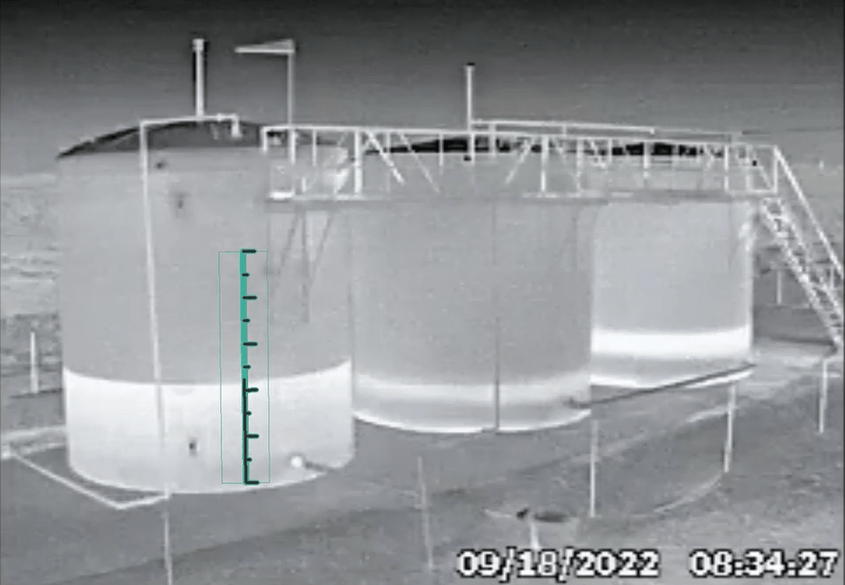 Thermal · Liquid line
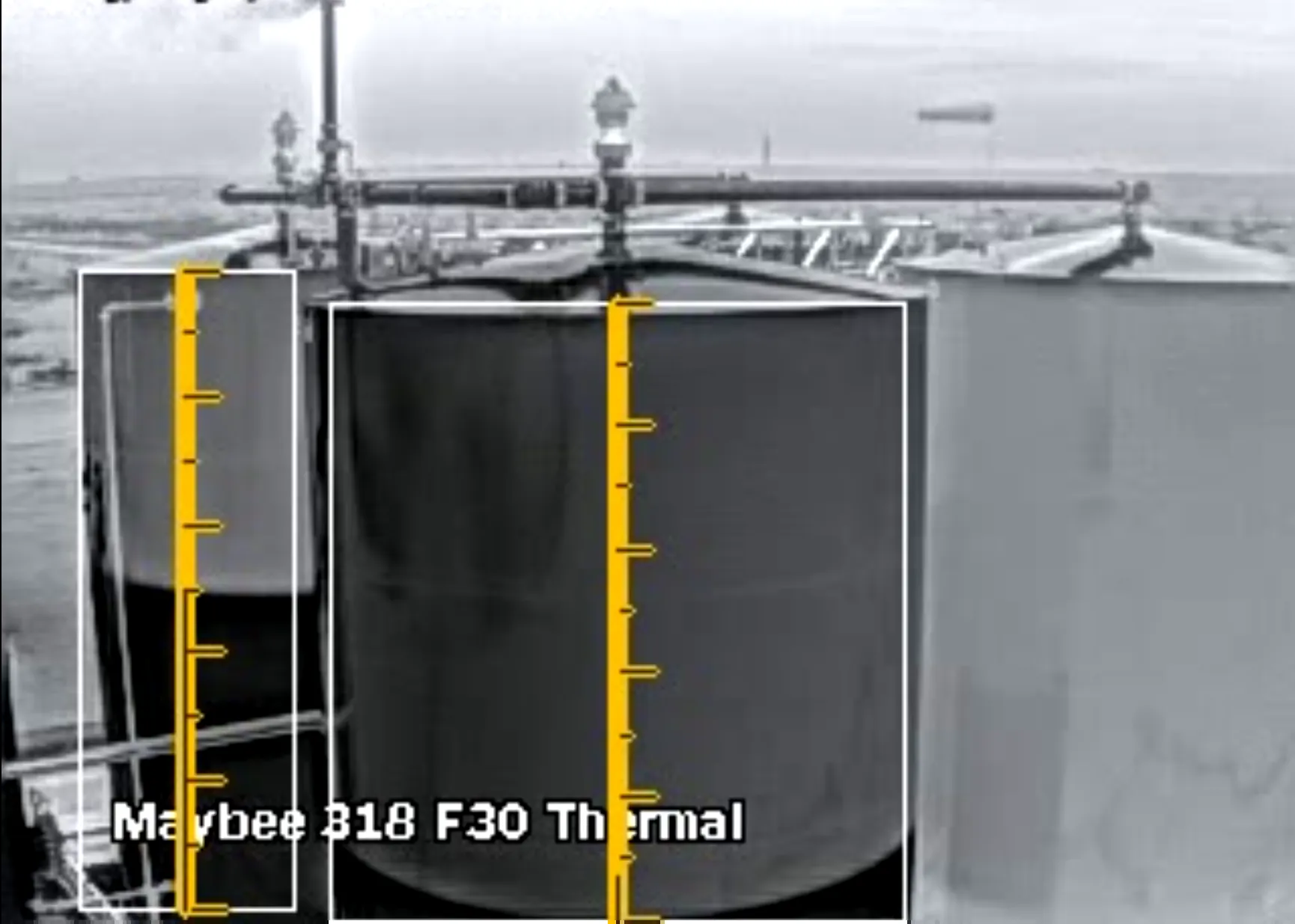 Thermal · Level scale
Want to see the thermal liquid line on your tank battery?
Schedule a POC and we'll stand up a temporary thermal camera with line-of-sight to one of your tanks, wire it to your SCADA tag, and show you the digital ruler running against your own fluid mix and day/night thermal gradient.
How it works
The digital ruler — measuring liquid level from outside the tank
VisionAery does not need any sensor inside the tank. It looks at the tank from the outside through a visible or thermal camera, and uses fixed reference features on the tank exterior as a ruler. The location where the visible (or thermal) liquid line crosses that ruler becomes the level estimate — accurate to roughly two pixels in the image.
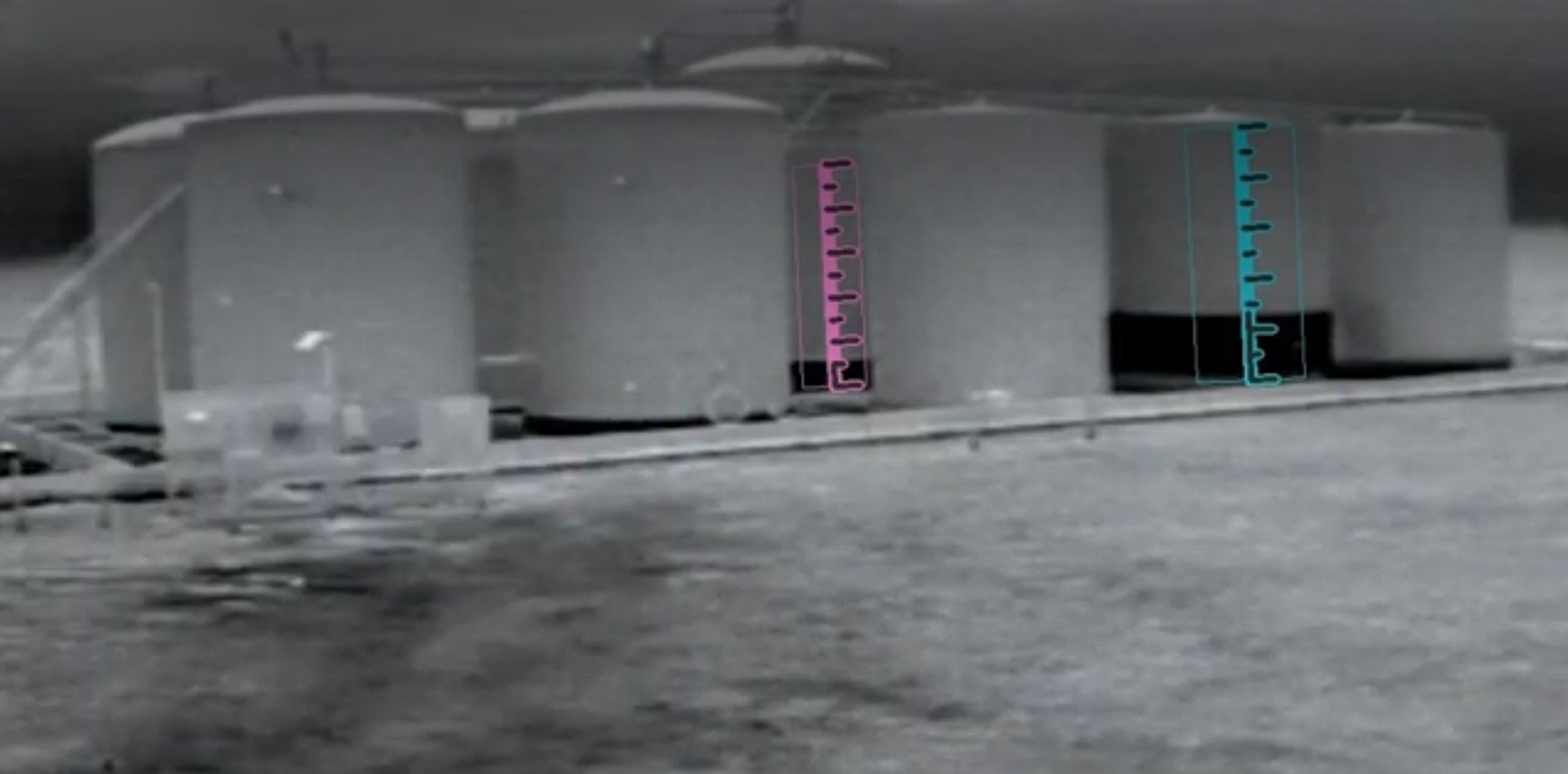 Live model output · multi-tank
STEP 01
Identify reference features
Twin Eagle identifies fixed, surveyable features on the tank exterior — manway flanges, ladder rungs, weld seams, paint marks, structural members — and pegs each one to a known physical height inside the tank. This per-tank work is done once, remotely, from a clear camera image.
STEP 02
Build the digital ruler
Those reference features become calibration ticks on a vertical ruler that the model overlays onto every frame — a digital staff gauge anchored to the tank itself. On thermal cameras, the same ruler is anchored against the LWIR frame, where the contrast between liquid and vapor space typically gives a much sharper level line.
STEP 03
Measure & publish
Inference runs continuously at the edge. The model locates the liquid line on each frame, reads off where it crosses the digital ruler, and publishes the level value, drift state, stuck-gauge state, and over-fill warning to SCADA via MQTT, OPC UA, Modbus, or REST. Accurate to roughly two pixels — no tank entry, no in-tank instrumentation.
Schedule a POC
See Tank Level prove itself on your batteries
A Twin Eagle field crew comes to a representative tank battery of yours, stands up thermal Tank Level Monitoring on a temporary thermal camera with line-of-sight to the shell, and runs the analytic against your real gauges — your existing SCADA level tag, your fluid mix, your day/night thermal gradient. You see the visual thermocline, the SCADA cross-confirmation, and the stuck-gauge / drift alarming end-to-end before any commitment.
- Tank-shell thermal camera survey and sightline planning by a Twin Eagle engineer
- Live visual-thermocline level inference on your actual batteries
- SCADA level-tag cross-confirmation wired into your historian for stuck-gauge / drift alarms
- POC report with detection samples, gauge-failure backstop scenarios, and a deployment plan
Thermal vision vs. traditional probes
Why a thermal camera is the right backstop on a tank battery
VisionAery does not replace the primary level instrument — it provides the independent visual confirmation layer the primary cannot self-report. The table below compares the failure modes of traditional in-tank probes against an outside-the-tank thermal-vision approach.
Concern
Traditional probe
Radar · float · ultrasonic · pneumatic
VisionAery thermal
Outside the tank · edge AI
Yes — typically requires taking the tank out of service
No — mounted externally on the camera
Common — vapor space exposed when tank is opened
None — no tank opening at any point
Recurring, instrument-specific (often by skilled technician)
One-time per-tank reference features, configured remotely
Probes can be degraded by aggressive media and require replacement
Camera sits outside the tank — never contacts the medium
One probe per tank
One camera can monitor multiple tanks (fixed FOV or PTZ patrol)
Stuck-gauge / drift is a silent failure — the SCADA value just stops being true
Independent visual signal — fires a stuck-gauge alarm when the two diverge
Calibration and maintenance require trained instrument techs on-site
Mount the camera; Twin Eagle configures and tunes remotely
Same instrument provides the high-high — early warning depends on the same potentially-failed signal
Independent visual layer fires ahead of high-high regardless of probe state
Wired or radio to SCADA — typically already in place
Edge inference; metadata-only WAN footprint — works on cellular or satellite
VisionAery Tank Level is a confirmation and backstop layer, not a primary measurement instrument. The SCADA-grade radar, float, or ultrasonic gauge remains the primary level signal in the operator's process-safety case.
What it does
Six capabilities that define VisionAery Tank Level
One model, six things it does well — mapped end to end.

VisionAery
TANK LEVEL
Visible Tank-Level Estimation
Digital-ruler estimation from imagery — accurate to roughly 2 pixels, independent of any SCADA gauge value.
Thermal Level Detection
Pairs with LWIR cameras for night, fog, and dark-tank scenes — works in any light or weather.
Stuck-Gauge & Drift Detection
Fires when the SCADA reading stops moving or drifts away from the visible level state.
Over-Fill Early Warning
Visible-level early warning well before the high-high SCADA setpoint trips.
SCADA Cross-Confirmation & Historian Integration
Publishes visible level, drift, stuck-gauge, and over-fill state into your existing SCADA and historian.
On-Prem Edge Compute
Runs entirely on the camera or a fanless NVIDIA Jetson Orin at the tank battery — minimal bandwidth, no cloud round-trip.
VisionAery
TANK LEVEL
Visible Tank-Level Estimation
Digital-ruler estimation from imagery — accurate to roughly 2 pixels, independent of any SCADA gauge value.
Thermal Level Detection
Pairs with LWIR cameras for night, fog, and dark-tank scenes — works in any light or weather.
Stuck-Gauge & Drift Detection
Fires when the SCADA reading stops moving or drifts away from the visible level state.
Over-Fill Early Warning
Visible-level early warning well before the high-high SCADA setpoint trips.
SCADA Cross-Confirmation & Historian Integration
Publishes visible level, drift, stuck-gauge, and over-fill state into your existing SCADA and historian.
On-Prem Edge Compute
Runs entirely on the camera or a fanless NVIDIA Jetson Orin at the tank battery — minimal bandwidth, no cloud round-trip.
Visible Tank-Level Estimation
VisionAery Tank Level Monitoring runs continuous inference on the tank-area camera feed and estimates visible tank level using a digital-ruler technique — fixed reference features on the tank (manway flanges, ladder rungs, paint marks), lighting cues, and shadow geometry combine into a level estimate that is accurate to roughly two pixels in the image. The level signal is produced independently of any SCADA gauge value, which is what makes it useful as a confidence check on the SCADA reading and as a coverage layer for tanks where the level instrument is failed, drifting, or absent. A single camera can monitor multiple tanks in its field of view, and PTZ cameras can sweep a tank battery and produce a level estimate for each tank in the patrol.
Thermal Level Detection
Where optical estimation is limited by tank coloration, lighting, or sight line, VisionAery pairs with thermal (LWIR) cameras. The thermal contrast between the liquid in the tank and the vapor space above it produces a sharp level line that is largely indifferent to ambient light, time of day, or weather — giving the operator a defensible level estimate at night, in fog, in rain, and on tanks where the visible exterior gives little away. The same digital-ruler technique is applied on the thermal frame.
Stuck-Gauge & Drift Detection
The visible level estimate is continuously compared against the SCADA reading. When the SCADA gauge stops moving while the visible level continues to change, when the SCADA value drifts away from the visible state, or when the two diverge by more than a configurable tolerance, VisionAery fires a stuck-gauge or drift alarm. The most common silent failure mode on a tank battery — a stuck gauge — becomes a visible event.
Over-Fill Early Warning
The expensive failure on a tank battery is the over-fill — liquid hydrocarbon over the top of the tank, into the dike, and onto the ground, with the regulatory and cleanup cost that follows. VisionAery's continuous visible-level signal supports an early-warning alarm well before the high-high SCADA setpoint, giving operations and on-call dispatch enough time to intervene before the tank tops.
SCADA Cross-Confirmation & Historian Integration
VisionAery Tank Level publishes its visible-level estimate, drift state, stuck-gauge state, and over-fill warning into SCADA via MQTT, OPC UA, Modbus, or REST — directly into the same historian and HMI environment your operations team already runs. The visible state can be configured as an independent input to alarm logic, a cross-check on the existing gauge, or as a calibration backstop on tanks where the level instrument has known reliability problems.
On-Prem Edge Compute
Tank Level inference runs entirely at the edge — either directly on a smart camera with on-board compute, or on a fanless NVIDIA Jetson Orin (Arm64) edge box installed at the tank battery alongside the camera. Detection, gauge cross-confirmation, and over-fill early warning all evaluate locally, so the analytic keeps working through internet outages, the camera feed never has to leave the site, and the link to corporate only has to carry small metadata (tank ID, current level, alarm events) — useful on the low-bandwidth cellular and satellite links that many tank batteries actually run on. The application is configured remotely over a secure channel — no on-site laptop, no skilled technician dispatched per tank. Models, thresholds, and per-tank reference features are managed through Twin Eagle's on-prem fleet management plane, with mTLS device identity and IEC 62443 / NIST-aligned controls.
Frequently asked questions about VisionAery Tank Level
Related VisionAery analytics
VisionAery Analytic · Flagship
Liquid Leak Detection
Continuous edge-AI for visible puddles, pressurized spray, and visible vapor plumes — with a working live demo.
VisionAery Analytic
Fire & Smoke Detection
Continuous detection of unintended flame, glow, and smoke — with explicit flare and heat-source discrimination.
Overview
AI Solutions
VisionAery, Remote Pumper, vendor analytics, the Aery Device Manager, and the full integration stack.
Backstop your tank-level program
Send us your tank inventory, your existing level-instrument types, and your SCADA architecture. We'll come back with a per-tank cross-confirmation plan and a real number, usually within one business day.